Commercial Roofing Services · Garden Grove, CA
Commercial Roof Recover and Overlay in Garden Grove, CA
Commercial Roof Recover and Overlay
Compare commercial roof recover and tear-off options in Garden Grove. We inspect layers, drainage, attachment, and transitions before setting the scope.
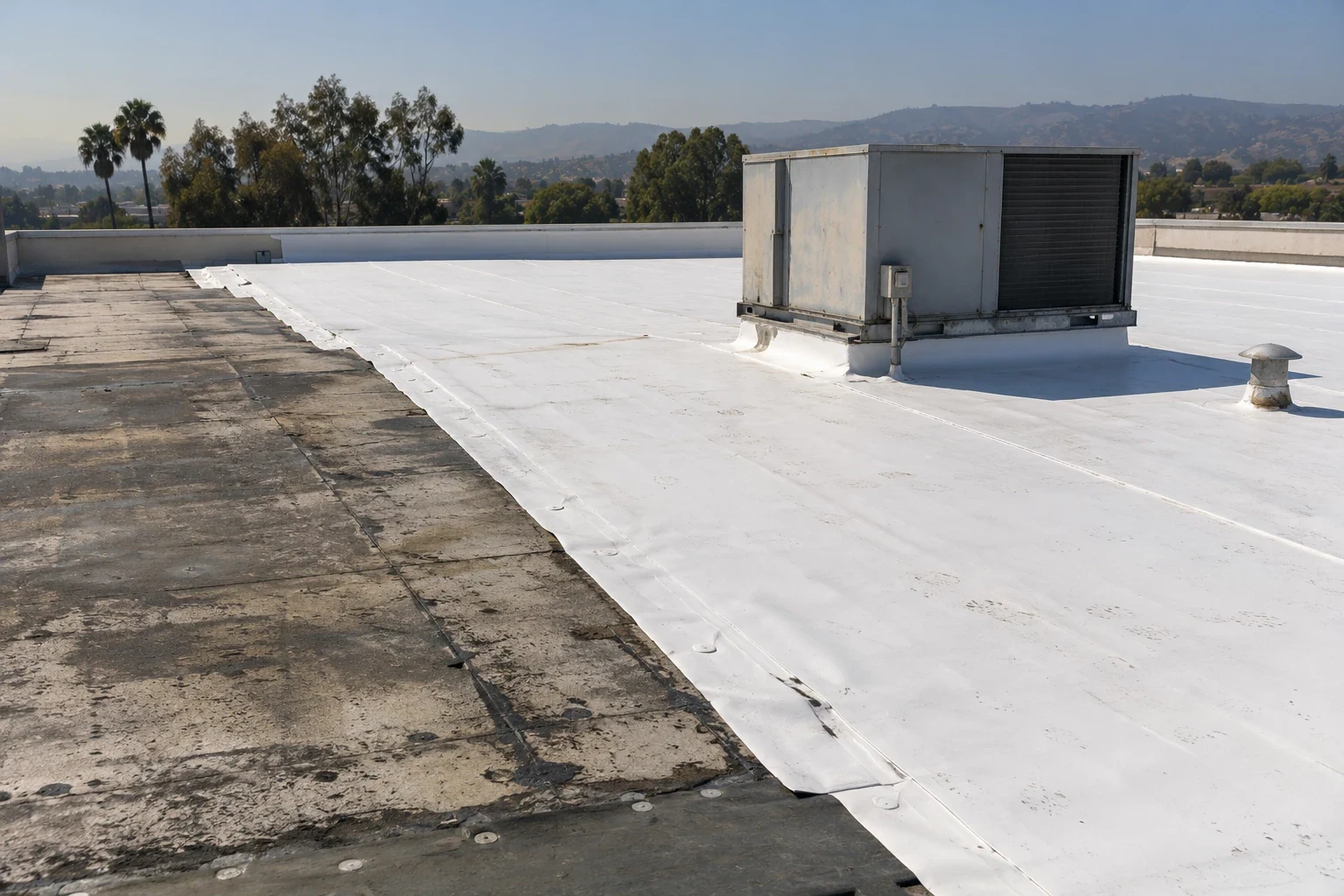
A second roof layer can be a sound option only when the first one gives it a stable base. On a commercial building in Garden Grove, CA, we start by checking how many layers are present, whether the existing membrane remains attached, and where water has reached the insulation or deck. A recover limits demolition and can shorten exposure, but it also keeps existing material in place. The roof's condition, drainage, and loading capacity decide whether that trade makes sense. We inspect the assembly before comparing a recover with tear-off, then write down what the new system can cover and what it cannot.
Read the Existing Layers Before Adding Another
At a seam or penetration, an intact surface does not prove the board below is dry. We review repair history, walk the field, check attachment, and trace water toward drains and wall transitions. Test cuts are useful when they answer a specific question about moisture, insulation, or deck condition. The inspection records each layer, the substrate, and locations where the assembly changes. If past patches have created several elevations, we also check whether the new work can maintain a continuous slope and secure termination. The resulting commercial roof inspection helps separate a limited recover candidate from areas that need removal before they are covered.
Garden Grove includes commercial, office, industrial, and mixed-use areas, so a roof can sit above loading, public access, or production equipment. Along the Knott Street and Western Avenue industrial district, roof access and equipment connections may affect where a test opening can be placed. We coordinate those details with the building contact while keeping the material decision tied to observed conditions. For the same reason, a moisture survey can help identify where to investigate, but its findings need confirmation before the recover boundary is approved.
Define What the Recover Leaves in Place
A recover proposal needs to identify the layers that will remain, the surface preparation required, and how the new assembly attaches. If the old membrane is loose, saturated, contaminated, or incompatible with the proposed system, a new layer may inherit the weakness. We mark wet or unstable areas for removal, then follow the edge until the remaining substrate can receive the new work. Around curbs and parapets, the detail must rise and terminate without trapping water between layers. Drains need a finished elevation that still accepts runoff, and door thresholds or equipment supports may need transition work when the roof height changes.
When the recover remains feasible, we compare attachment methods against the deck and existing assembly. A mechanically attached system, adhered membrane, or cover board can each change uplift resistance, installation access, and the way seams are finished. The TPO assembly and PVC assembly should be evaluated with compatible adhesives, fasteners, and flashing details rather than as material names alone. Where existing conditions call for a different route, a full replacement gives the crew access to the substrate and concealed transitions.
Match the New Roof to Its Base
Recover work adds weight and height, so we confirm deck capacity and the intended attachment before choosing insulation or cover board. A separation layer may be needed between incompatible materials; its purpose is to protect adhesion and keep the new system within its tested assembly. The specification lists membrane type, attachment, insulation, cover board, flashing, and perimeter conditions. It should also identify details that stay in place and components that require replacement. On Garden Grove buildings with mixed commercial and office use, the operating schedule can affect whether adhesive application, material staging, or fastening is practical during occupied hours.
The adopted 2025 California Building Code and local modifications in Title 18 form part of the permit review. We confirm applicable requirements with the building official and coordinate project-specific details with the design team. Code review does not replace checking the existing roof's condition or the compatibility of new and old materials. A clear restoration scope can be compared with a recover when the surface is suitable for coating, but the choice follows the actual substrate and water management rather than a preference for less demolition.
Keep Openings Small and Dry-In Points Clear
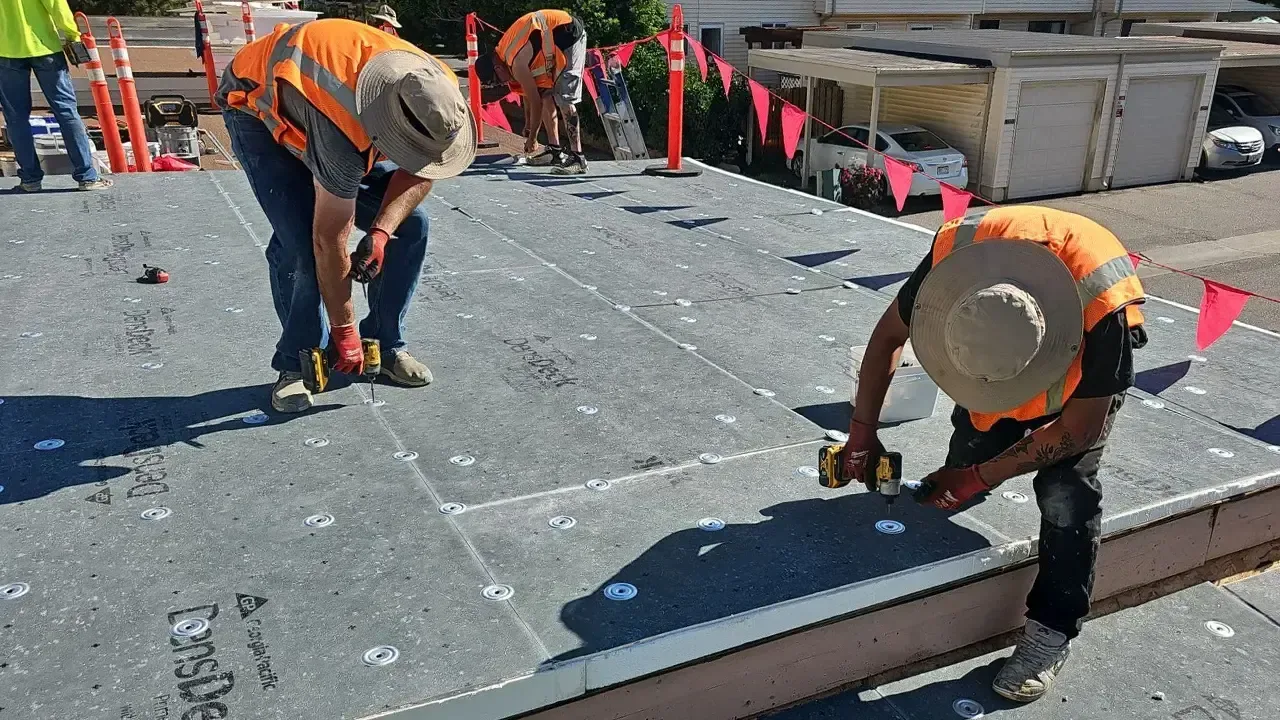
Keeping the existing roof in place reduces the area exposed during installation, but work still needs a daily protection plan. We divide the roof into manageable zones, set a dry-in point, and confirm how materials reach the roof without blocking required access. Before the first fastener or adhesive is applied, the crew identifies drains that must remain clear and the sequence for tie-ins at walls, curbs, and adjacent roof sections. If weather or a concealed condition interrupts work, the planned stop must leave the building protected. That boundary is especially useful above occupied rooms or active production areas.
Garden Grove's commercial streets include Harbor Boulevard, Beach Boulevard, and Brookhurst Street, while Trask Avenue has a planned auto-sales and repair cluster. On a property with vehicle circulation, a delivery and hoist path should stay separate from active bays where possible. Our occupied-building sequence sets access, staging, and communication points before the roof zone changes. If the existing roof cannot provide a reliable dry-in surface, we revise the work limits rather than assuming a recover will remain weather-tight overnight.
Record the Assembly That Remains
At closeout, we check seams, perimeter attachment, curbs, wall transitions, and drain elevations. The file records which material layers remain, where removal occurred, and how the new membrane ties into existing details. Photographs make the boundary visible for future repair or inspection. The owner should receive the system description and the maintenance requirements that apply to the installed materials, without a claim that the recover removes all future risk. This record also helps a later service visit distinguish a new condition from a pre-existing patch or transition.
After installation, debris at a drain or damage from later equipment work can interrupt the flow path even if the membrane is intact. We can set a maintenance schedule for seams, flashings, and drains. A localized defect can then be evaluated against the documented recover boundary; if an issue needs prompt attention, our repair service can assess the affected roof zone. The goal is a known assembly, a clear scope, and a practical record of what the roof needs next.
Commercial Roofing Questions
When is a recover a reasonable alternative to tear-off?
A recover is considered when the existing assembly is stable, sufficiently dry, attached to a sound substrate, and compatible with the new system. We also check layer count, drainage, perimeter height, deck capacity, and applicable code limits. If those conditions do not support another layer, removal exposes the substrate and lets us address concealed damage before new material is installed.
Can a recover cover wet insulation?
No. Wet or deteriorated insulation needs to be located and removed to a suitable boundary before it is covered. We use inspection findings and, when useful, test openings to determine what can remain. The scope identifies replacement areas and the approval point for concealed conditions so the crew does not bury a known moisture problem.
Will an additional roof layer affect drains and equipment curbs?
It can. Added thickness changes the elevation at drains, wall edges, curbs, doors, and adjacent roof sections. We record each transition, confirm whether extensions or new flashing are needed, and verify that water can still reach the drains. The detail schedule should show those changes before the recover begins.
What should I compare in two recover proposals?
Compare the layers each proposal leaves in place, how it verifies moisture and attachment, the new system and fastening method, drain and edge details, and how concealed repairs are approved. Also compare staging, daily dry-in, and the closeout record. A lower demolition scope may not be comparable if it omits preparation or transition work.
Measure the roof before choosing the repair path
Arrange a roof walk with available plans, leak records, and access constraints. We will trace the assembly, mark the work boundary, and prepare a scope for your Garden Grove building.
Or call 555-555-5555 · [email protected]