Garden Grove, CA · Commercial Roofing
Roof Systems
Roof Systems in Garden Grove
A seam that has lifted at one corner tells us to inspect the weld, the material around it, and how the edge is secured. The system name matters because repair methods, preparation, and tie-ins differ. We identify the installed assembly at your Garden Grove building before comparing TPO roofing, EPDM, metal, or coating options. The decision follows the roof’s condition and use, not a list of materials in isolation.
All Roof Systems
Commercial TPO Roofing
Commercial TPO roofing in Garden Grove, CA includes membrane, insulation, attachment, flashing, tested seams, and documented closeout.
Commercial PVC Roofing
Commercial PVC roofing in Garden Grove, CA covers welded seams, compatible flashing, attachment, drainage, and maintenance requirements.
Commercial EPDM Roofing
Commercial EPDM roofing in Garden Grove, CA addresses seams, adhesive preparation, flashing, insulation, and repair boundaries by roof zone.
Commercial KEE Roofing
Commercial KEE roofing in Garden Grove, CA specifies compatible membrane, welded seams, attachment, flashing, and documented field testing.
Commercial Modified Bitumen Roofing
Commercial modified-bitumen roofing in Garden Grove, CA details reinforced plies, lap repairs, flashing, application controls, and maintenance.
Commercial Built-Up Roofing
Commercial built-up roofing in Garden Grove, CA evaluates asphaltic plies, surfacing, flashing, drainage, repairs, and the condition of each roof layer.
Commercial Standing-Seam Metal Roofing
Commercial standing-seam metal roofing in Garden Grove, CA evaluates panels, clips, movement, flashing, drainage, and compatible repairs.
Commercial Metal Roof Retrofit
Commercial metal roof retrofit in Garden Grove, CA evaluates structure, attachment, drainage, panel movement, equipment access, and replacement alternatives.
Commercial Spray Polyurethane Foam Roofing
Commercial SPF roofing in Garden Grove, CA inspects foam profile, moisture, coating wear, drainage, overspray controls, and repair options.
Commercial Silicone Roof Coatings
Silicone roof coating in Garden Grove, CA checks adhesion, moisture, drainage, substrate repairs, application conditions, and ongoing roof maintenance.
Commercial Acrylic Roof Coatings
Acrylic roof coating in Garden Grove, CA reviews adhesion, drainage, surface preparation, repairs, application windows, and maintenance needs.
Read the Existing Layers
We inspect the membrane or panels, seams, attachment, flashing, insulation clues, drainage, and perimeter details. Repair patches and coatings can hide earlier conditions, so we note what can be confirmed and where records or testing are needed. A recover is appropriate only when the retained assembly and deck can accept another layer. If moisture or movement reaches beyond a local defect, removal and replacement may provide a clearer boundary.
Single-ply choices include thermoplastic and elastomeric membranes. A PVC assembly and an KEE membrane require product-specific material matching, while seams and flashing must be compatible with the installed system. For multi-ply roofs, we check the surfaced layers and transitions before choosing a repair material.
Compare Materials by the Detail
Material selection starts with the repair boundary. A seam repair depends on surface cleanliness, temperature, and compatible joining methods. Metal work may involve panel laps, exposed or concealed fasteners, and transitions where water changes direction. A standing-seam roof behaves differently from a modified-bitumen assembly, so the scope should name the observed construction and the proposed tie-in.
Coatings can extend a suitable assembly’s service when substrate, adhesion, drainage, and details qualify. They do not correct a wet roof or unstable edge by themselves. We inspect first, then compare coating, recover, and tear-off paths with the owner. Garden Grove’s plan identifies commercial and industrial uses as well as mixed-use areas, so access and occupied-space protection also inform the installation sequence.
Carry the System Through Each Transition
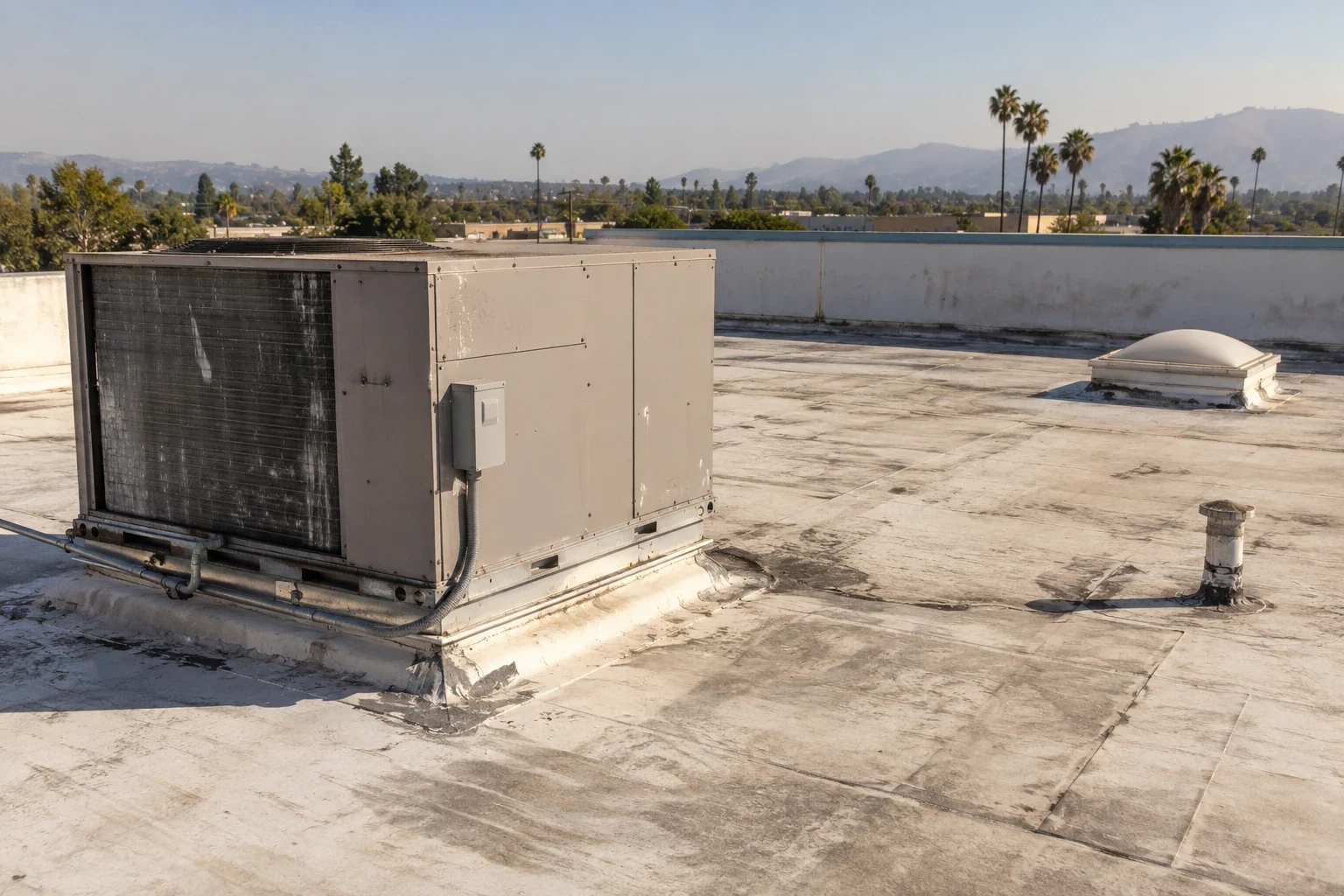
Field seams are only part of the assembly. Drains, curbs, wall terminations, expansion joints, and perimeter edges need a compatible detail and a stable receiving surface. At rooftop equipment, we inspect the curb and flashing where service work may have disturbed the membrane. Our cover board and insulation work can be considered when the scope calls for assembly changes; a perimeter detail repair addresses the roof-to-wall transition.
We phase work around safe access, building operations, and temporary protection. A walk through Garden Grove’s industrial district may involve different loading and equipment constraints from an occupied office, but the installed roof determines the technical method.
Verify the Completed Tie-In
At closeout, we confirm that seams, edges, and penetrations meet the specified detail and record any remaining access restrictions. This gives the property team a baseline for later service. A follow-up inspection can compare the completed tie-in with nearby roof zones after equipment or trade work.
Commercial Roofing Questions
How do you identify a roof when the records are incomplete?
We inspect accessible layers, seams, flashing, attachment clues, and prior repairs, then note what remains uncertain. A controlled opening or project record may be needed before the material and scope are finalized.
Can a coating go over any commercial membrane?
No. The surface must be compatible, prepared, dry, and stable, and the roof must drain properly. We check adhesion and detail conditions before recommending a coating system.
Does one system work for every roof zone?
An assembly may change across additions, repairs, or different roof levels. We document those transitions and select materials that can be joined safely to the existing construction.
What changes the cost of a system replacement?
Removal depth, substrate condition, insulation needs, edge and penetration work, access, staging, and weather protection all affect scope. We measure those items before comparing replacement options.
Request a Roof Assessment
Compare commercial roof systems in Garden Grove by assembly condition, drainage, attachment, and repair access before selecting a scope.
Or call 555-555-5555 · [email protected]